(4-8-2) Nutrition Detective Lander

Why does your face look different than it used to?
Not because you gained weight. Not because you "got older." Something else may be happening. And over 20,000 people have been exploring what it is.

Featured in
You've felt it. Maybe not all at once. But over time... you started noticing things.
Your face looks different in photos. Not just "older." Different. Like the proportions shifted. Your jawline feels less defined. Your face feels flatter. Narrower.
And it's not just your face. Your posture changed. Your neck feels tighter. Your shoulders roll forward more than they used to. You get tension headaches. You wake up tired... even after a full night's sleep.
And when you look in the mirror... you don't quite recognize the person staring back.
You know SOMETHING changed. But you can't explain what. Or why.
Here's the working theory behind this
Most people think their skull is one solid bone. It's not. It's 22 separate bones. Connected by soft tissue. Fascia. Muscle. Ligaments.
There's a theory developed by an Ivy League-educated engineer who spent an entire decade obsessively testing this on himself. It's now been explored by thousands of people around the world.
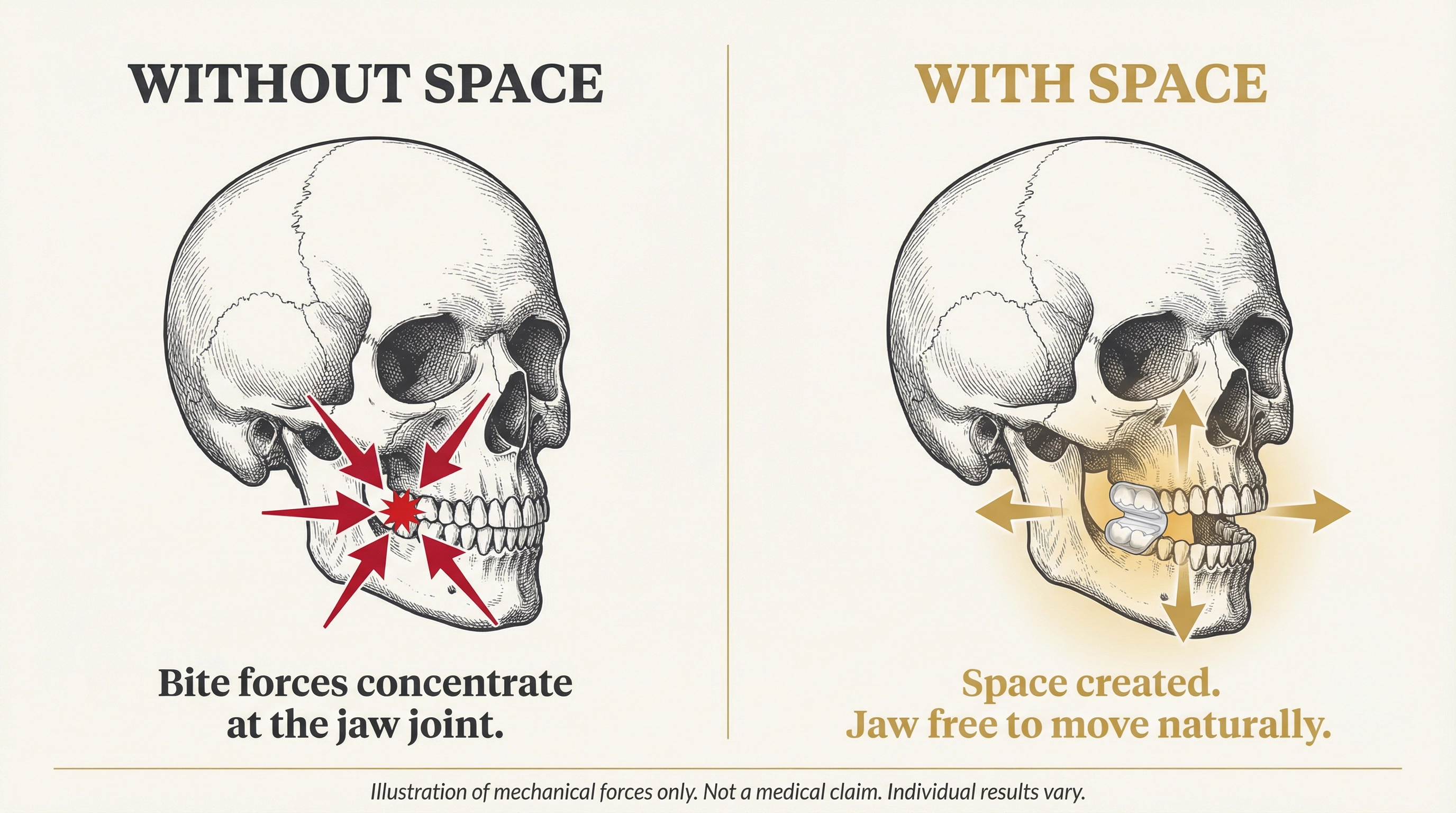
The theory: your back molars may act like a lock on your jaw. When they're compressed together... your jaw can't move freely. The soft tissue covering your skull may stay compressed. But when you create space between those back molars... the lock may release. Your jaw can move more naturally.
Based on 10 years of self-experimentation, this appears to allow the body's natural adaptation process to engage.
Think of it like a balloon. When the balloon is fully inflated... your face may feel wider. More supported. But over time... certain things may let air out of that balloon.
Teeth grinding. Orthodontics that flattened your bite. Wisdom teeth removal. Dental work that ground down your teeth.
The working model is that all of these may compress your jaw. And when your jaw closes more... the soft tissue covering your skull may tighten. Your face may feel narrower. Your posture may shift forward to compensate. Sleep quality may suffer. Energy may drop.
This engineer believes the structure of your skull may affect how your entire body functions. And based on what thousands of users have reported... there may be something to it.
This is a working theory based on personal experimentation and user experience, not a medical claim. Individual experiences vary.
What the Reviv community is reporting
“I've been wearing it every night for two months. The difference in how I feel in the morning is noticeable — less tension, more energy, clearer head.”— Daniel R., verified buyer
“Six weeks in and my jaw tension has reduced noticeably. I sleep through the night now which I hadn't done consistently in years.”— Sarah M., verified buyer
“I was skeptical. Three months later I'm a convert. The changes were gradual but they're real.”— Tom K., verified buyer
“My chiropractor actually asked what I'd been doing differently. I told him about Reviv. He was curious.”— Priya S., verified buyer
Individual results vary. These statements reflect personal experience and have not been evaluated by the FDA. The R3 is not intended to diagnose, treat, cure, or prevent any disease.
So who figured this out?
A guy named Ken.
Ken was a normal guy growing up in America. Played hockey. Had his wisdom teeth pulled at 21. Got some crowns after chipping his teeth. Standard stuff.
But throughout his 20s and 30s... he dealt with constant neck and back tightness. He averaged 2–3 medical visits per week. Chiropractors. Physical therapists. Neurologists. He'd been to every department in the hospital. Nothing worked long-term.
Then in 2013... he was living in Ukraine. A dentist told him he might have TMJ. Made him a flat splint to wear. And within a few weeks... all the tightness disappeared. Ken thought the guy was a magician.
But then the first war in Ukraine started. He moved his family to Vietnam. Chewed through the splint within weeks. Found a TMJ dentist in Vietnam who said... "Let me adjust your dental contacts."
So he sat there while the dentist drilled down his back teeth. Ken had no idea what was happening.
Within a couple of months... everything changed. Severe mental fatigue rolled in. He didn't want to leave the house. He asked to be demoted two levels at work because if he didn't write something down... it was gone from his head 5 minutes later.
This was 2014. Ken was 37 years old.
And for the next 10 years... he became obsessed with understanding what had happened. He tried every approach he could find. DIY appliances. Different splints. Various methods. He tested everything on himself.
By late 2021... he believed he finally understood the mechanics. And more importantly... how to potentially support his body's natural recovery process.
What Ken developed — based on years of personal experimentation — is a simple device designed to create consistent space between your back molars while you sleep.
He calls it the R3.
Ken's experience is personal and individual. Results from using Reviv vary by person.
Even licensed medical professionals have taken notice.
Meet Dr. Garrett Smith, NMD

Dr. Garrett Smith is a licensed naturopathic medical doctor. His entire family works in dentistry.
His son is currently in braces. When those braces come off, the orthodontist will hand him a standard wire retainer — designed to keep teeth in place.
Dr. Smith isn't planning to use that retainer.
Because he believes that retainer may lock the jaw. And when the jaw gets locked... he believes the body's natural adaptation process may be restricted.
Dr. Smith is planning to use the R3 instead — because it's designed to create space rather than restrict movement.
He doesn't just recommend this. He uses it himself.
“I feel the difference when I wear it. My breathing feels easier. I feel like I recover better after workouts. When my son's braces come off, he'll be using this — that's how much I trust it.”— Dr. Garrett Smith, NMD (personal experience, not a product claim)
Dr. Smith is an affiliate of Reviv and receives compensation for referrals. His statements reflect personal experience only.
What can you expect?
This isn't an overnight thing.
The first week or two may be uncomfortable. Your teeth and gums might ache. Sleeping through the night with it in can take adjustment. But once you get past that initial phase... that's when many people start noticing changes.
Individual experiences vary. Results are not guaranteed. The R3 is not intended to diagnose, treat, cure, or prevent any disease.
Here's what you're getting
The R3 is a silicone mouthguard designed to create space between your back molars while you sleep.
Made from premium silicone. Worn while you sleep — and ideally 1–2 hours during the day if possible. It sits between your teeth, creating space in your back molars.
Based on Ken's model, this spacing is designed to support your body's natural adaptation process. It doesn't force your teeth into position. It creates space and lets your body respond naturally over time.

- Medium (63.5mm wide, 46mm deep, 23mm tall) — Smaller builds
- Large (73.2mm wide, 53.6mm deep, 26mm tall) — Most adults
- Extra Large (84mm wide, 59.6mm deep, 27mm tall) — Bigger frames
Most people use Large. If you're unsure, email cs@getreviv.com before ordering.
- The R3 mouthguard (your choice of size)
- Hard protective case
- Detailed instructions
- 1-Year Warranty (1 free replacement per customer)

Two ways to get started
Option 1: R3 + 1 Year Community Access — $150
- The R3 mouthguard
- Full year of Skool community access
- Community support (3,000+ members)
- 60+ educational videos from Ken
- The 'FAST method' stretches to support results
- Free shipping
Questions?
Your structure is either being supported or it isn't
Every day your bite stays compressed... your body may be working harder than it needs to. Most people don't notice until something prompts them to look closer.
But based on what Ken and thousands of users have experienced... your body may have more capacity to adapt than you think. You just have to give it the space to do so.
Some people feel something shift within days. Others notice changes over weeks and months. Most people who use this consistently report that something changes — in how they sleep, how they feel, how they move through their day.
Imagine if:
→ You woke up actually feeling rested. Not just technically having slept.
→ The tension you carry in your neck and jaw started to ease.
→ Your thinking felt clearer in the mornings.
→ Your posture shifted — not because you forced it, but because something underlying changed.
Individual results vary. Not everyone experiences these outcomes.
That's what thousands of users have reported. But if it does work for you... you'll wish you started sooner.
Get The R3 Now — Start TodayP.S. Ken uses this himself. His wife and son use it. Over 20,000 people use it. And Dr. Smith (affiliate) chose this for his son instead of a standard retainer. That should tell you something.